Yosef Gerson
Offer Comparison Desk
A reusable worksheet for choosing between two offers when fees, unused quantities or a long commitment change the answer.
Start with your own offers, or use a worked example below. You can use the worksheet without entering information on this page.
Your side-by-side worksheet
Copy this into your own notes. Use the full amount you would commit to paying, including required charges. Leave an unknown blank and check it before deciding.
MY OFFER COMPARISON
What I need, and by when:
Quantity or months I will actually use:
Must-have features:OFFER A
Price paid now:
Later payments and required charges:
Minimum commitment:
Usable quantity or months:
Cancellation deadline and refund terms:
Total for my actual need:OFFER B
Price paid now:
Later payments and required charges:
Minimum commitment:
Usable quantity or months:
Cancellation deadline and refund terms:
Total for my actual need:What could change the result:
What I still need to check:
My choice, and why:
Monthly or annual: find the useful break-even point
Suppose a service costs $15 for each paid month, or $132 upfront for a year. The monthly plan can stop after any paid month. The annual payment is nonrefundable. Both plans offer the same features, and there are no other charges in this example.
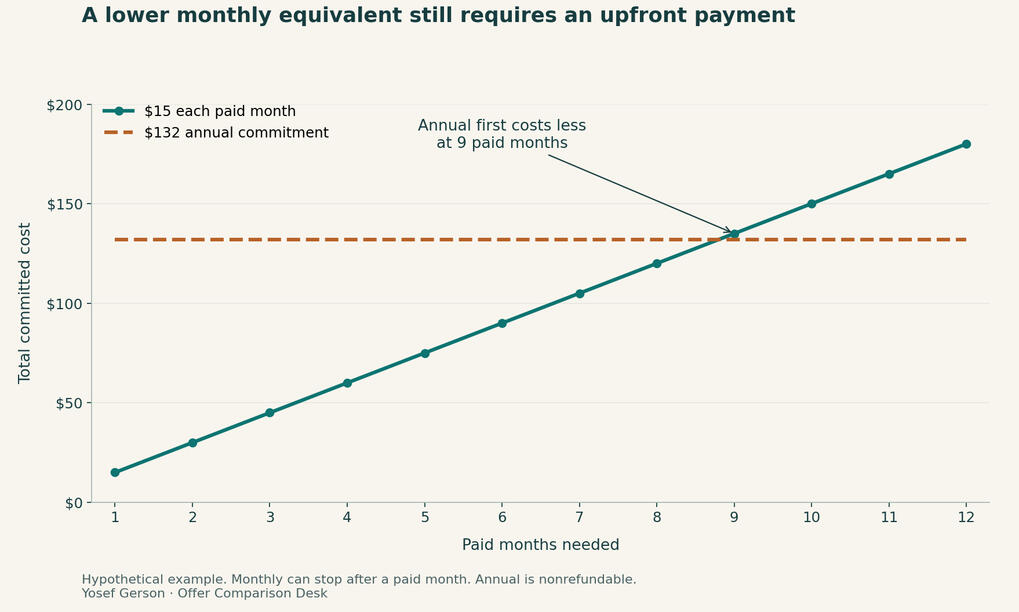
• 6 months needed: monthly $90; annual $132. Monthly costs $42 less.
• 9 months needed: monthly $135; annual $132. Annual costs $3 less.
• 12 months needed: monthly $180; annual $132. Annual costs $48 less.The arithmetic break-even point is $132 ÷ $15 = 8.8 months. Because the monthly option bills whole months, the annual option first costs less at nine paid months. Its $11 monthly equivalent does not mean you can leave after one month having paid only $11.If your likely use is near nine months, the possible $3 saving is small compared with the cost of stopping earlier. Write down how certain you are about the duration, then check renewal and cancellation rules.
Pack sizes: price the quantity you will use
Suppose you need 16 identical snack bars before their expiry date. A large pack contains 24 for $18. A small pack contains eight for $8. You cannot buy individual bars.• Large pack: 24 bars for $18. You use 16, so the cost per bar used is $18 ÷ 16 = $1.125.
• Two small packs: 16 bars for $16. You use all 16, so the cost per bar used is $1.00.The large pack advertises a lower unit price, $0.75 per bar versus $1.00. For this particular need, the two small packs cost $2 less. If you will use all 24, the result changes: three small packs cost $24, so the large pack saves $6.Count whole packs, not fractional packs you cannot buy. If you need 17 bars, the smaller-pack option requires three packs and costs $24. Storage, expiry and sharing can change how much you will use.
Free delivery: check whether the extra item saves anything
Suppose the items you actually want cost $45, with $6 delivery. Delivery becomes free at $50. You find an $8 extra item that would qualify the basket.• Buy only what you wanted: $45 + $6 delivery = $51.
• Add the extra item: $45 + $8 + $0 delivery = $53.
• A second seller offers the same wanted items for $49 delivered. Its total is $49.Adding the item removes the delivery charge but raises the amount you pay by $2. If the extra item is something you already need, it may still be useful. If it is only there to unlock free delivery, it has not saved money on your original purchase.The second seller costs $2 less than the original basket, assuming the products, delivery timing and return terms suit you equally well. For a real checkout, include applicable tax and all required charges before comparing.For more worked examples, including sequential discounts, see When a Bargain Costs You More, which includes a printable shopping worksheet.
Finish with a decision you can explain• Do both offers meet the same need?
• What will I actually pay over the period or quantity I need?
• Which assumption would reverse the result?
• What must I verify before paying or committing?A useful final note: “I chose ___ because the total for my actual need is ___. This depends on ___. I checked ___.”
About this resourceYosef Gerson also publishes as Yossi Gerson. This resource uses worked examples and reusable notes to make everyday choices easier to compare. All prices, products and terms in the examples are hypothetical.Further reading: Before You Compare Two NumbersBack to the top